|
CESD
Oil Transparency Conference
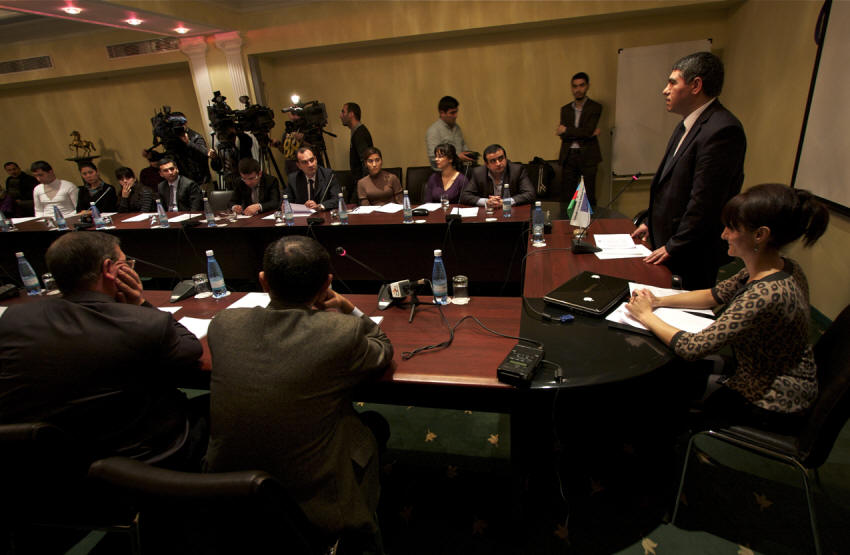
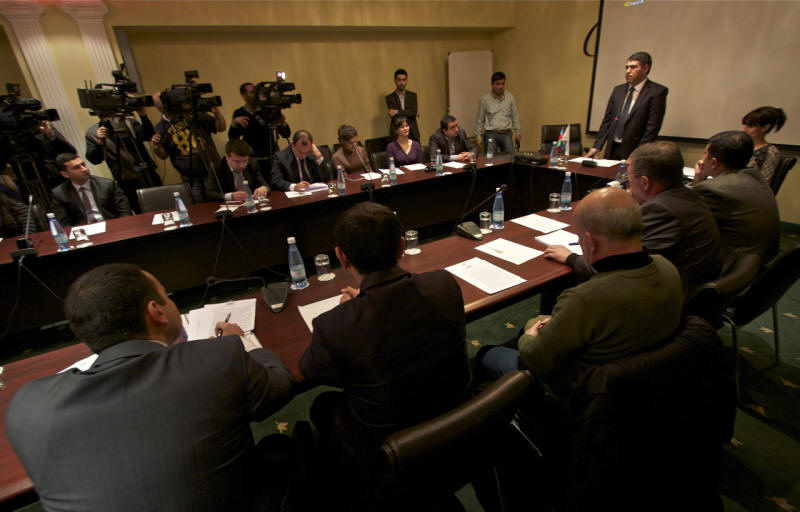
CESD held Oil Transparency Conference in Baku on
December, 14, 2010 with participation of various
stakeholders
The Center for Economic and Social Development (CESD),
with support from the US Embassy in Azerbaijan,
is carrying out the monitoring of tenders that
are financed by oil revenues. Round-table
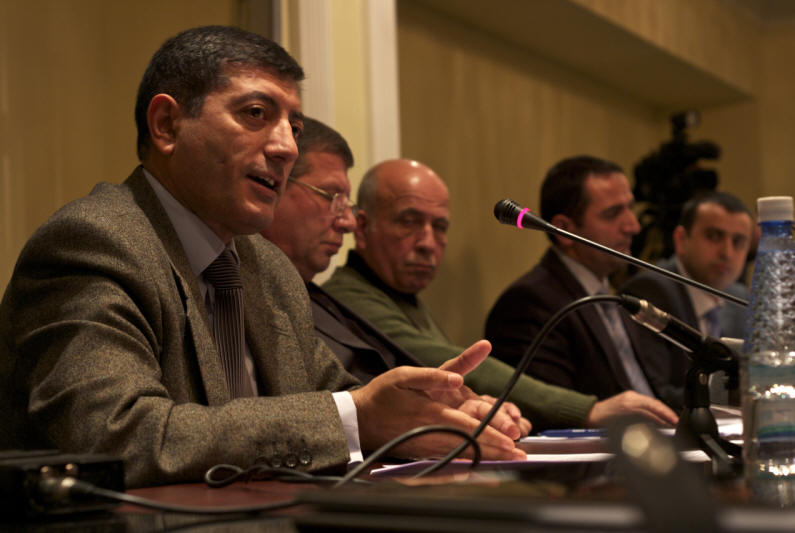
discussions with participation of
representatives from government, non-government,
international organizations, mass-media were
held in December 14, 2010. Representatives of
State Oil Fund, State Irrigation Committee,
World Bank, different embassues, Oil Research
Center and other organizations attended the
round-table discussions.
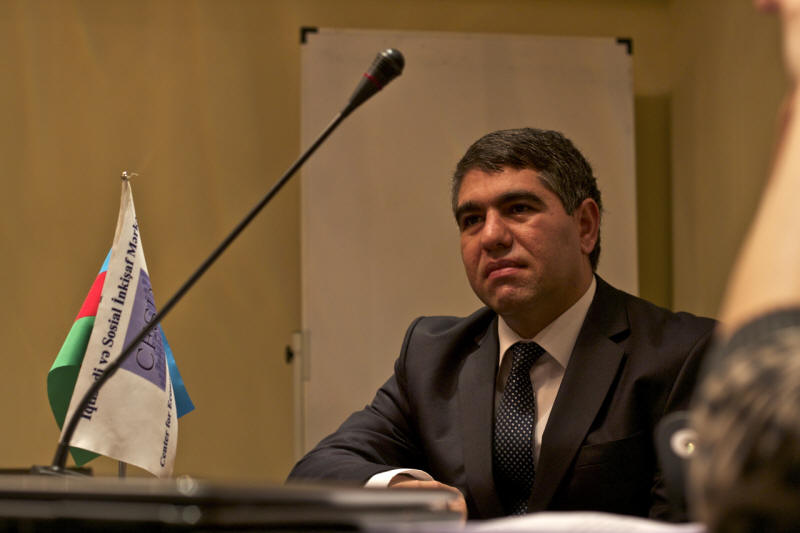
Vugar Bayramov, chairman of CESD, mentioned
that the aim of the project is to support the
more efficient use of oil incomes and to raise
the level of transparency in this field. This is
the reason why the monitoring of tenders
financed by the Oil Fund has taken place.
Leyla Aliyeva, Project manager, said that during
the monitoring, it was discovered that while
selecting bidders, the authorities have, in most
cases, not followed the demands of the “Law
on State Procurement.”
In the official documents, it is declared that 7
tenders for the reconstruction of the
Samur-Absheron irrigation system and 10 tenders
for the construction of the Oguz-Gabala-Bakı
irrigation system were to be held.
But the press announcements regarding these
projects do not match the number of contracts
that were signed. This means that contracts
have not been signed as the outcome of
procurements. The increasing values of such
projects and the prolongment of the period of
implemenation have discouraged transparent
tender processes to be carried out.
For example, the construction of the
Oguz-Gabala- Baku irrigation system is
continuing 3 years into the project. Even though
it
was
said that it would be completed in November, the
works have not yet been finished.
International tender experience shows that the
tender is awarded to the organization offering
the lowest cost budget and the shortest
implementation period.
The most interesting thing about the
Oguz-Gabala-Baku irrigation system is that the
contract was signed with an inactive
organization. That is why the demands of the
“Law
of State Procurement” were broken.
This is because the professionalism, technical
and financial opportunity,
management,
and reliability of the organization in this
field have been defined as the main priorities
during tender selection. However, we cannot
discuss the professionalism, experience, and
management skills of an
organization that is not active.
Among the projects funded by the State Oil Fund,
the most critical situation about the tender
transparency is in the area of improving the
social welfare status of refugees and internally
displaced people. Until 2007, the 3 client
organizations for these project were the State
Committe on Deals of Refugees and Internally
Displaced Persons,
the Social-Development Fund of Displaced People,
and the Agency of the Reconstruction and
Rebuilding of the Occupied Territories
It has resulted that these organizations did not
take their responsibility for the tenders.
The monitorings that we conducted show that
there is not any legal base
considering
the timing of the tenders, about the names of
the participants that were selected, about the
sharing of the incomes according to the
districts, and about the technical-economic
justification
of said project.
Because, in reality, tenders are not held by
these organizations. 10-15 tenders are organized
in all 100 work. Up to this time, the work is
divided between the same organizations. Of the
16,051 homes that have been built, there is
still no information about which organisation
built them, if they were selected by tenders or
not,
what the condition of the tender was, and the
mechanism of the spending of such incomes.
The procurement of the execution of the works
for the joint Baku-Tbilisi-Kars railway project
of three countries –Turkey, Azerbaijan, and
Georgia, was held according to the legislation
of Georgia and Turkey. That is why these
tenders are different from the project tenders
that are funded by the State Oil Fund. Thus,
there are tender announcements about the
project. These announcements also show the
materials that should be bought, the volume of
the
work that should be done, the technical
parameters of the project, and the volume of the
cargo that should be carried by the railway in
the first stage.
The most important thing is that the
“Marabda-Kartsaxi Railway LLC”, which is
responsible for the execution of the project
from the Georgian side, implemented seperate
tenders in different service sectors.
Nevertheless, according to the project of the
construction of the Oguz-Gabala irrigation
system, the rebuilding of the Samur-Absheron
irrigation system, and the improvement of the
social welfare status of refugees and internally
displaced families, there are no tender
announcements related with account and sevices
like this.
The negative sight of the tenders implemented
according to the projects is keeping the
technical parameters a secret. If a transparent
tender process were to be held, the technical
parameters of the projects would be known.
The length of the Oguz-Gabala-Baku water pipe is
not clear. The contractor organizations show
one number and the client shows a different
number for the length. In the project of the
rebuilding of Samur-Absheron irrigation system,
technical parameters are not shown. During the
implementation process of the project of the
improvement of the social welfare status of
refugees and internally displaced persons,
several works were postponed. For example, there
are no bath–houses in most settlements.
On the other hand, executive organizations
assigned to the projects are institutions which
have close relations with the the government.
Only the organisations that are very close to
governmental bodies are permitted to implement
tenders. Other organisations are not allowed to
participate by different pretexts. Though they
are allowed to the tender with great
deprivations, again, the winners of the large
projects are the organizations that are close to
the governmental bodies.
 |